1. Observe
  2. Detect
  3. Correlate
  4. Respond

Your AI.
Our watch.

AsrielNetworks continuously monitors your AI applications and agents, detects attacks and abnormal behaviour in their traces, correlates activity into security incidents, and helps you respond before damage is done. One console, one tenant-isolated data model, twelve deterministic rules over every trace.

The platform

See it, catch it, close it

Three parts of one console, each fed by the same telemetry and the same detection engine.

Real-time visibility

See your AI estate, always.

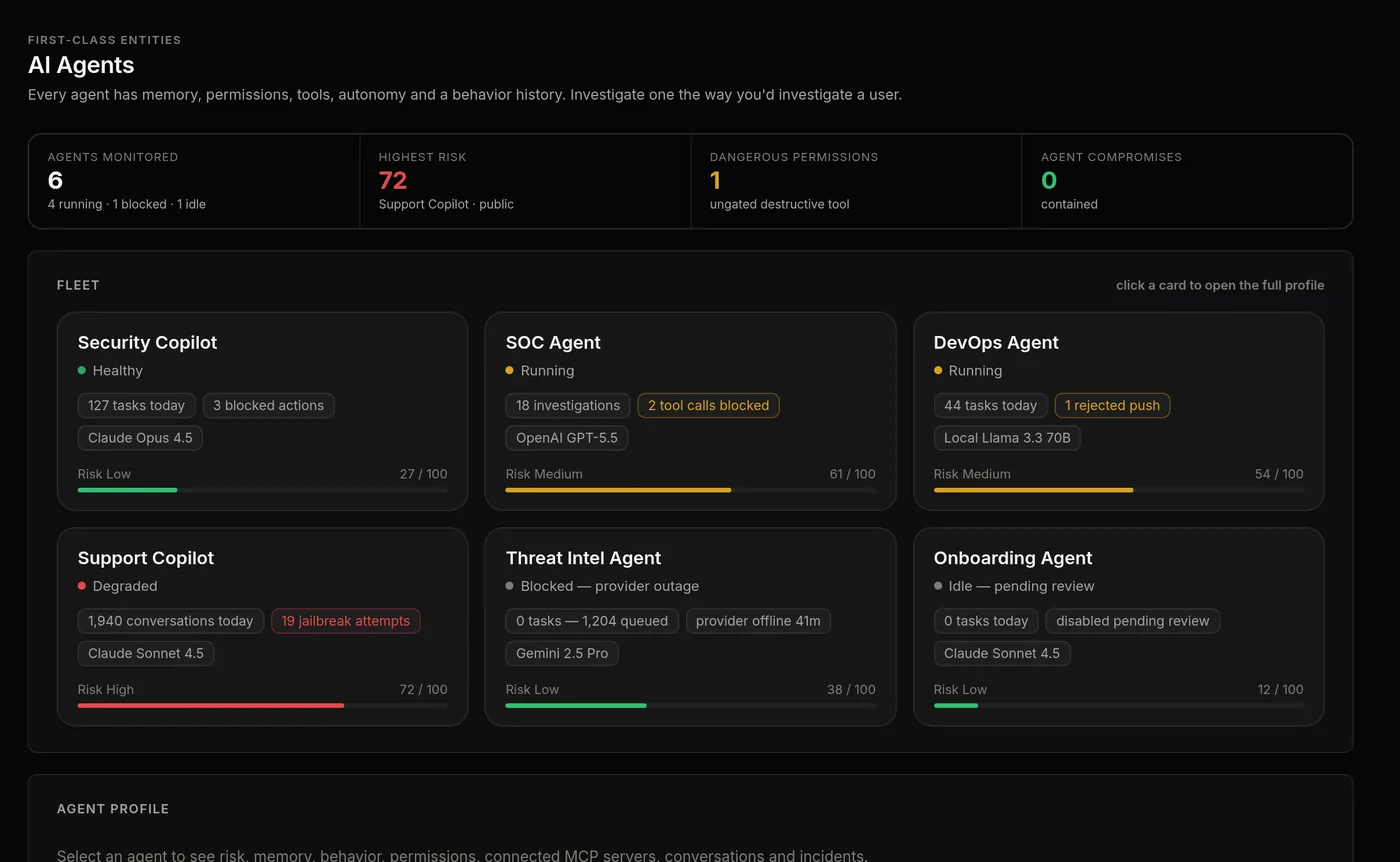
Every agent is a first-class entity with memory, permissions, tools, autonomy and a behaviour history. Models, deployments, MCP servers and retrieval corpora are inventory, not log lines.

The AI Agents page: six agents with status, tasks today, blocked actions, the model each runs on and a risk score out of 100.
  • Monitor agents, models, tools and MCP servers
  • Track where people and credentials act from
  • Spot a fleet risk score moving before an incident does
Deterministic detection

Stop threats before they spread.

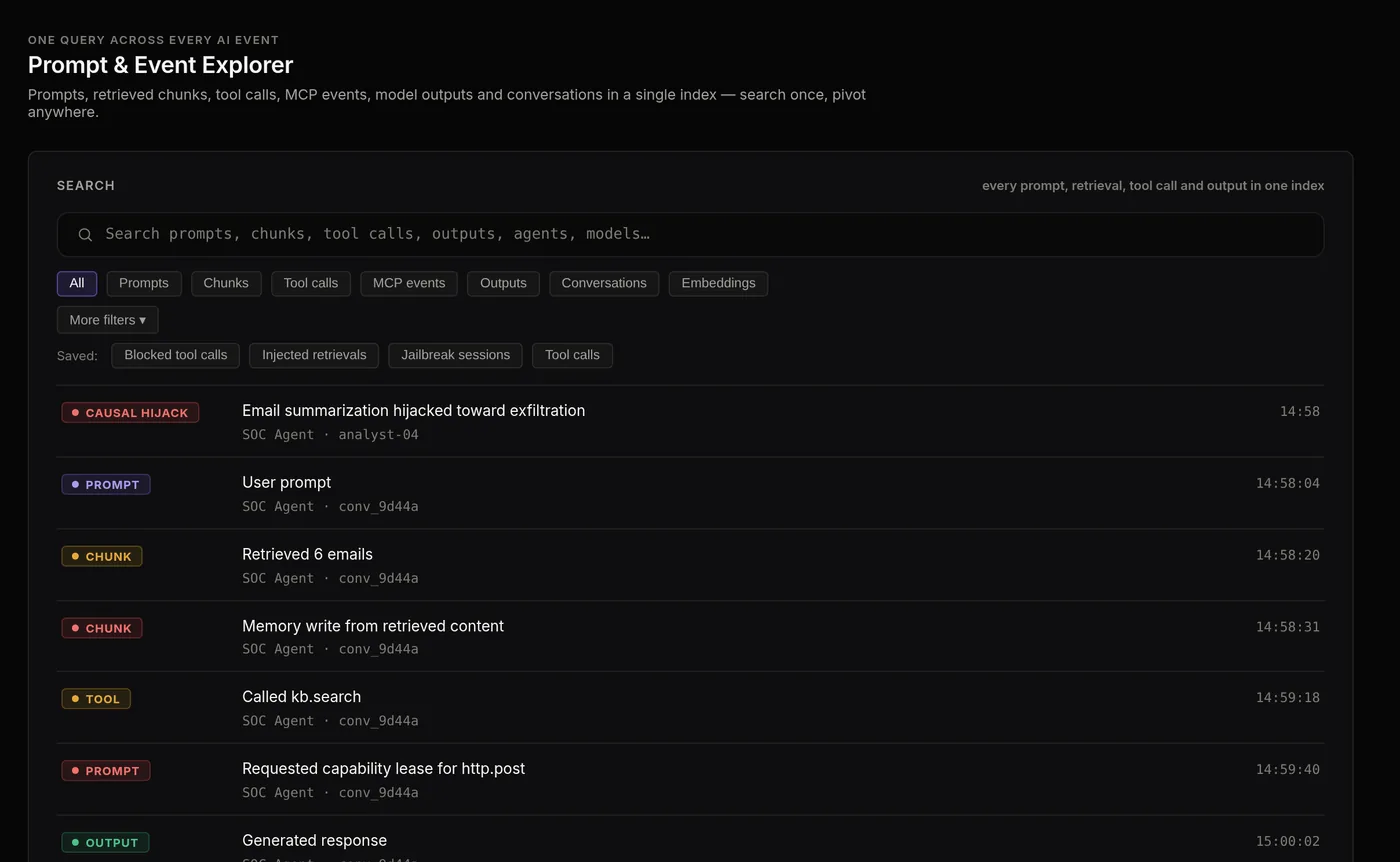
Prompts, retrievals, tool calls and responses arrive as ordered traces. Twelve code-backed rules evaluate each event with its trace window, inline in the request path or on a queue.

The Prompt and Event Explorer: a session's prompts, retrieved documents, tool calls and responses in order, with the findings raised on each.
  • Direct and indirect prompt injection, RAG poisoning
  • Tool use outside grants, bypassed approvals, misdeclared risk
  • MCP tool poisoning and name collisions
Incident response

From finding to action.

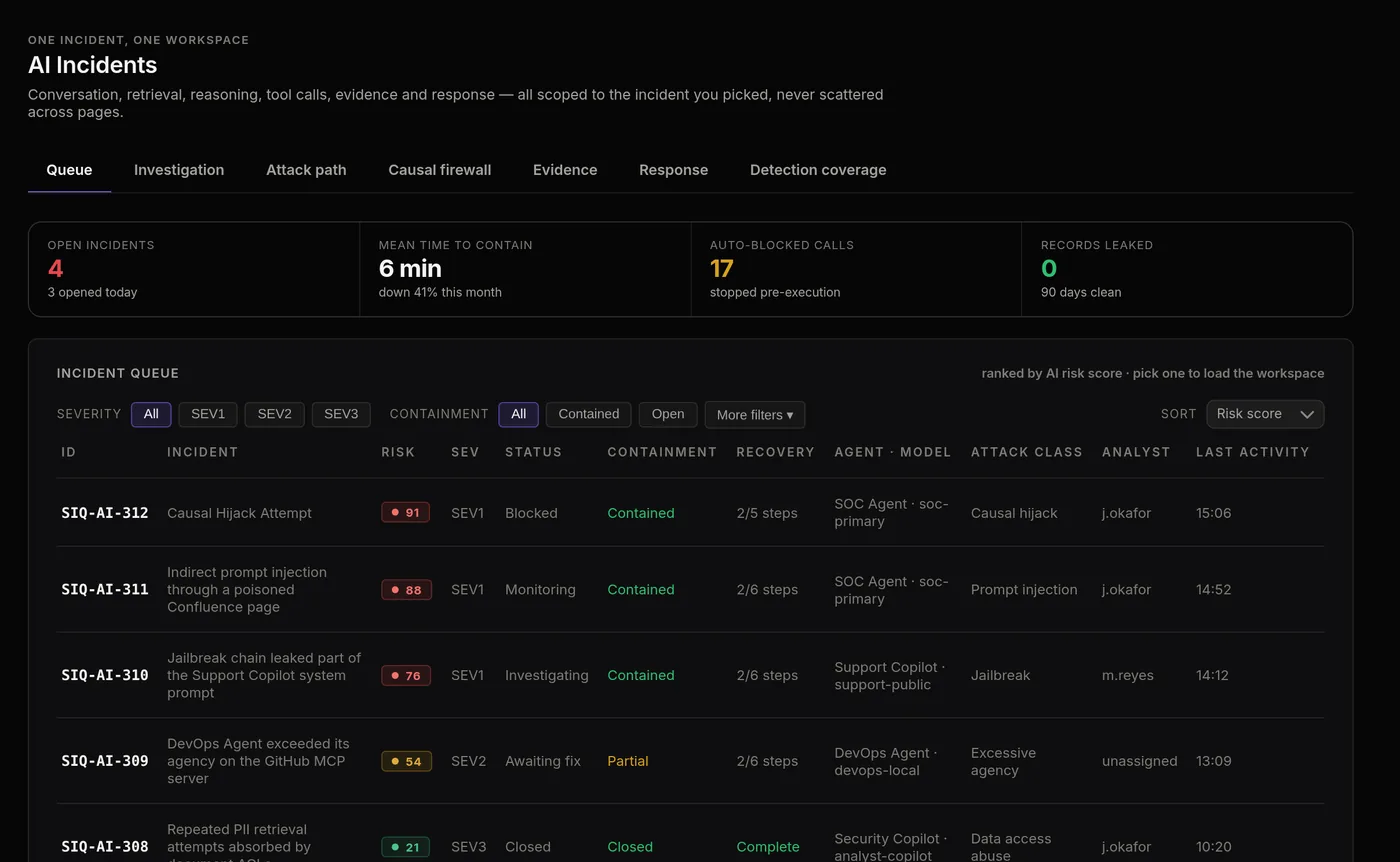
Findings that share a trace, session or agent become one incident with a risk score, a narrative, the attack path, sealed evidence and a response plan derived from the rules that fired.

The AI Incidents queue: incidents ranked by risk score with severity, status, containment, recovery steps, agent and model, attack class and analyst.
  • Correlate findings across trace, session and agent
  • Investigate with evidence, attack path and the causal firewall
  • Contain with approvals, isolation and playbooks
Users map

Where your AI is reached from

Every sign-in, API key and agent check-in, placed on the map. A credential that appears from a new country, or from two places one journey apart, is flagged before anyone has to notice.

  • People and credentials on separate layers, never summed
  • Blocked calls drawn where they came from
  • Drag the globe. Hover a country.
In every tier
sample data
Architecture

From an event to an incident

One tenant's data moves through these stages. Storage is PostgreSQL with row-level security forced on every tenant table; the application role cannot bypass it.

STAGE 1

Runtime

Your agent, LLM app or MCP host, instrumented with the SDK or routed through the gateway.

  • Machine credential scoped to an application, agent and deployment
  • Tenant locator inside the key, hash verified server-side
STAGE 2

Ingest API

Schema validation, allow-listed identifiers, sequence and trace binding, per-credential rate limits.

  • POST /api/v1/ingest/events batches
  • One rejected event does not sink the batch
STAGE 3

Prompt-event store

Sessions and traces as ordered events, each with kind, title, redaction state and structured data.

  • Content stays redacted where you said so
  • Search by trace, agent, tool, decision
STAGE 4

Detection engine

Every detector sees the current event, the trace window and recent security events. Inline or queued.

  • 12 built-in rules, tenant-configurable thresholds
  • Idempotent findings by fingerprint
STAGE 5

Correlation

Findings become incidents with a risk score, narrative, path nodes and evidence; repeat signals attach rather than duplicate.

  • Causal trace and counterfactual replay on Enterprise
  • Response plan derived from the rule set
STAGE 6

Consoles and API

Role checks, plan gates and step-up on sensitive actions sit on every route; the consoles call nothing the API does not expose.

  • Hash-only Content Security Policy
  • Append-only audit log

Gateway branch

Requests to /gateway/v1 enter at stage 3 as prompt events after the proxy call, so an inline deployment and an SDK deployment produce the same trace shape and are detected by the same rules.

Trust boundaries

Tenant isolation is a database property (RLS keyed on a per-transaction session setting), not a query convention. Credentials are stored as SHA-256 hashes; rotation issues a replacement and revokes the original at once. Sensitive actions require a fresh second factor.

Live AI attack graph

Prompt to response, with the controls that held

The console's signature panel. Traffic flows through retrieval, the model, tools and the database; a blocked call dies at the stage that stopped it.

live sample traffic · click a stage
completed refused or held blocked
Detection

The built-in rules

Each rule is code, versioned and tenant-configurable, and names the event types it listens to. The concept pages in Learn explain the attack each one targets.

RuleDetectsCategorySeverityLearn
ai.prompt_injection.direct Direct prompt injection
Structured injection verdicts and deterministic instruction-override signals in received or scanned prompts.
prompt injection high Concept
ai.prompt_injection.indirect Indirect prompt injection
Untrusted retrieved instructions correlated with a later sensitive tool proposal in the same trace.
prompt injection high Concept
ai.tool.unauthorized Unauthorized tool use
Tools outside the agent's grants, policy-denied proposals, and execution after a denial.
excessive agency high Concept
ai.data.sensitive_exposure Sensitive data exposure
Scanner and policy signals on outputs and transfers, evaluated without storing the raw values.
data access abuse high Concept
ai.rag.poisoning RAG poisoning or contamination
A suspicious retrieved document, distinguished from confirmed influence over a risky action.
supply chain medium Concept
ai.intent_action.divergence Intent-action divergence
Declared task category compared with the explicit tool category and side effects.
causal hijack high Concept
ai.action.concealment_risk Concealed action risk
A benign final status that omits risky or blocked effects recorded earlier in the trace.
causal hijack medium Concept
ai.control.repeated_failure Repeated security control failure
Repeated policy denials or guardrail failures aggregated over a bounded window (3 in 60 minutes by default).
excessive agency high Concept
ai.tool.risk_misdeclared Tool risk declared below its inferred class
A tool call declared a category or governance class below what its name implies; declarations can escalate, never downgrade.
excessive agency medium Concept
ai.mcp.tool_poisoning MCP tool poisoning
Model-directed instructions inside an MCP tool description, or a description that changed between sightings in one trace.
supply chain high Concept
ai.mcp.approval_bypass Privileged tool call bypassed its gate
A destructive- or secrets-class tool executed with no broker decision in a trace where other calls were gated.
excessive agency high Concept
ai.mcp.tool_shadowing MCP tool name collision
Two MCP servers exposed or served the same tool name inside one execution trace.
supply chain medium Concept
Integration

Three ways in

Pick the one that matches where your agent runs. All three produce the same trace shape.

SDK or your own emitter

Send asrielnetworks.ai.event.v1 batches with a machine credential in X-API-Key. Twenty-odd event types; this one is a denied tool call that opens an incident on its own.

{
  "schema_version": "1.0",
  "event_id": "evt_01j8x2",
  "event_type": "tool.denied",
  "timestamp": "2026-09-19T09:41:07Z",
  "trace_id": "t-4f2a9c",
  "session_id": "sess_t-4f2a9c",
  "sequence": 7,
  "application": { "external_id": "support-copilot" },
  "agent": { "external_id": "triage-agent" },
  "data": { "tool": "records.drop_table", "reason": "outside_scope" },
  "security": { "trust_level": "trusted", "policy_decision": "deny" }
}

Inline gateway

Register a provider and a deployment in the console, then change one base URL. The key carries a gateway:use scope.

curl https://<your-host>/gateway/v1/chat/completions \
  -H "X-API-Key: siq_…" \
  -H "Content-Type: application/json" \
  -d '{"model": "support-copilot-prod", "messages": [...]}'

Runtime telemetry

For hosts without the SDK: single prompt, tool and response events on /api/v1/telemetry/events, same credential model, same detection.

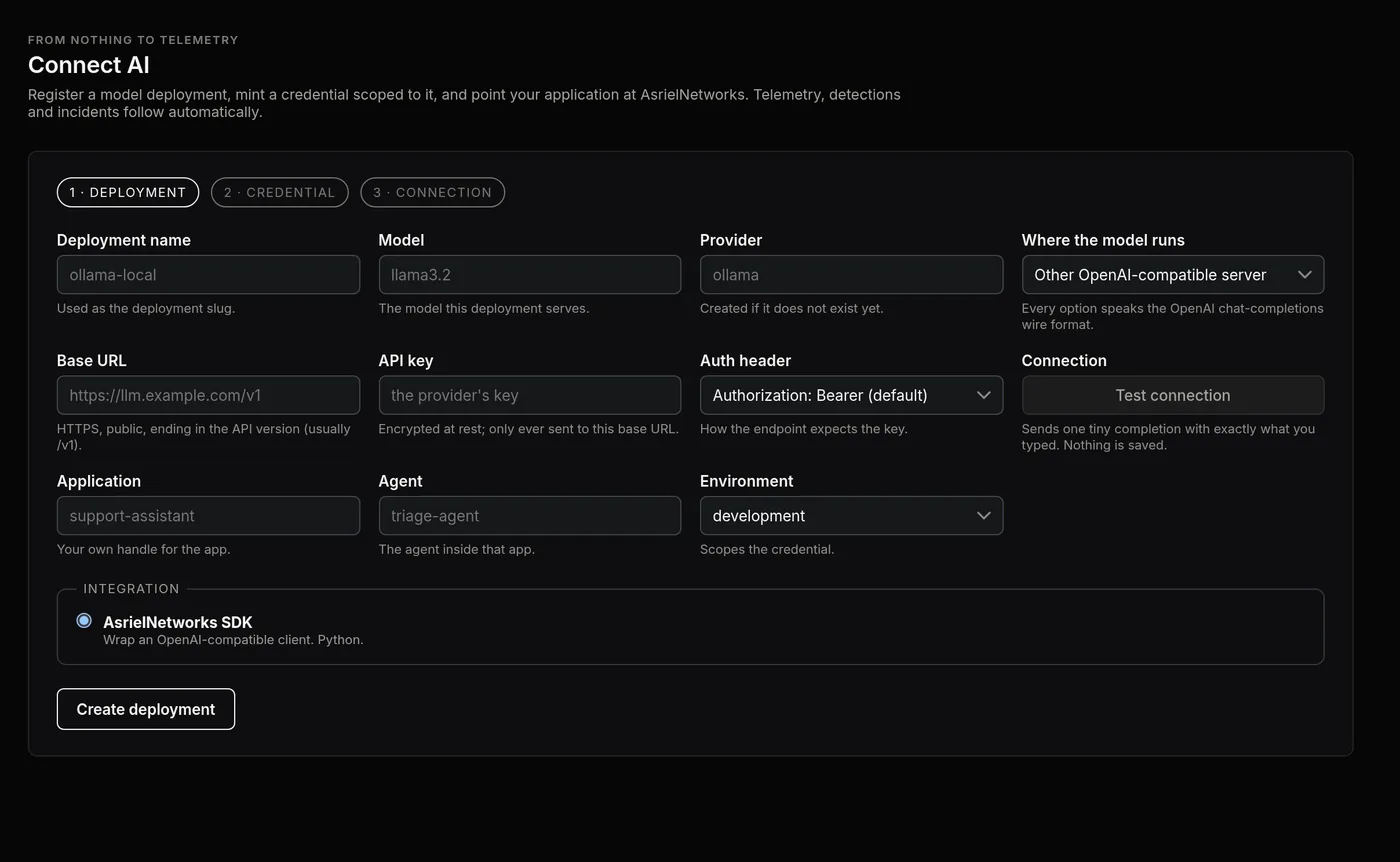
The Connect AI page: register a deployment (name, model, provider, base URL, API key, auth header), scope a credential to an application and agent, and test the connection.
Connect AI in the console: deployment, credential, connection.