 AsrielNetworks
AI security concepts, tied to the rules that detect them
A short library for practitioners: what each attack is, how it shows up in a trace, how AsrielNetworks detects it, and where to read further. Search runs in your browser over an index built from these pages; nothing is sent anywhere.
Nine concepts, three families
Each page names the built-in rules it exercises; the chips are the rule keys you will see on findings.
Input and instructions
Attacks that arrive through what the model reads and how it is told to behave.
Prompt injection
Instructions delivered through model input that override the operator's intent, directly in the user turn.
Indirect prompt injection
Instructions planted in content the model will read later: a web page, a document, an email, a tool result.
Guardrail evasion
Techniques that get a request past input filters, output classifiers or policy checks: obfuscation, encoding, role play, repetition, splitting.
Agency and tools
What an agent is allowed to do, and how the tool layer is subverted.
Excessive agency
An agent with more tools, permissions or autonomy than its task needs, so a single bad decision becomes a real side effect.
MCP tool poisoning
Model-directed instructions hidden in an MCP tool's description or schema, read by the model but not by the person approving the tool.
MCP tool shadowing
A second MCP server exposing a tool with the same name as a trusted one, so calls are routed to the attacker's implementation.
Data and supply chain
What the system is built from and what leaves through it.
RAG poisoning
Contaminating a retrieval corpus or vector index so that retrieved passages steer the model toward an attacker's outcome.
Data exfiltration
Sensitive data leaving through the model's output or a tool call: rendered links, encoded payloads, outbound requests, or plain disclosure.
Model supply chain
Compromise of the artifacts an AI system is assembled from: weights, adapters, datasets, tool servers and the packages that load them.
Every concept maps to a rule you can watch fire
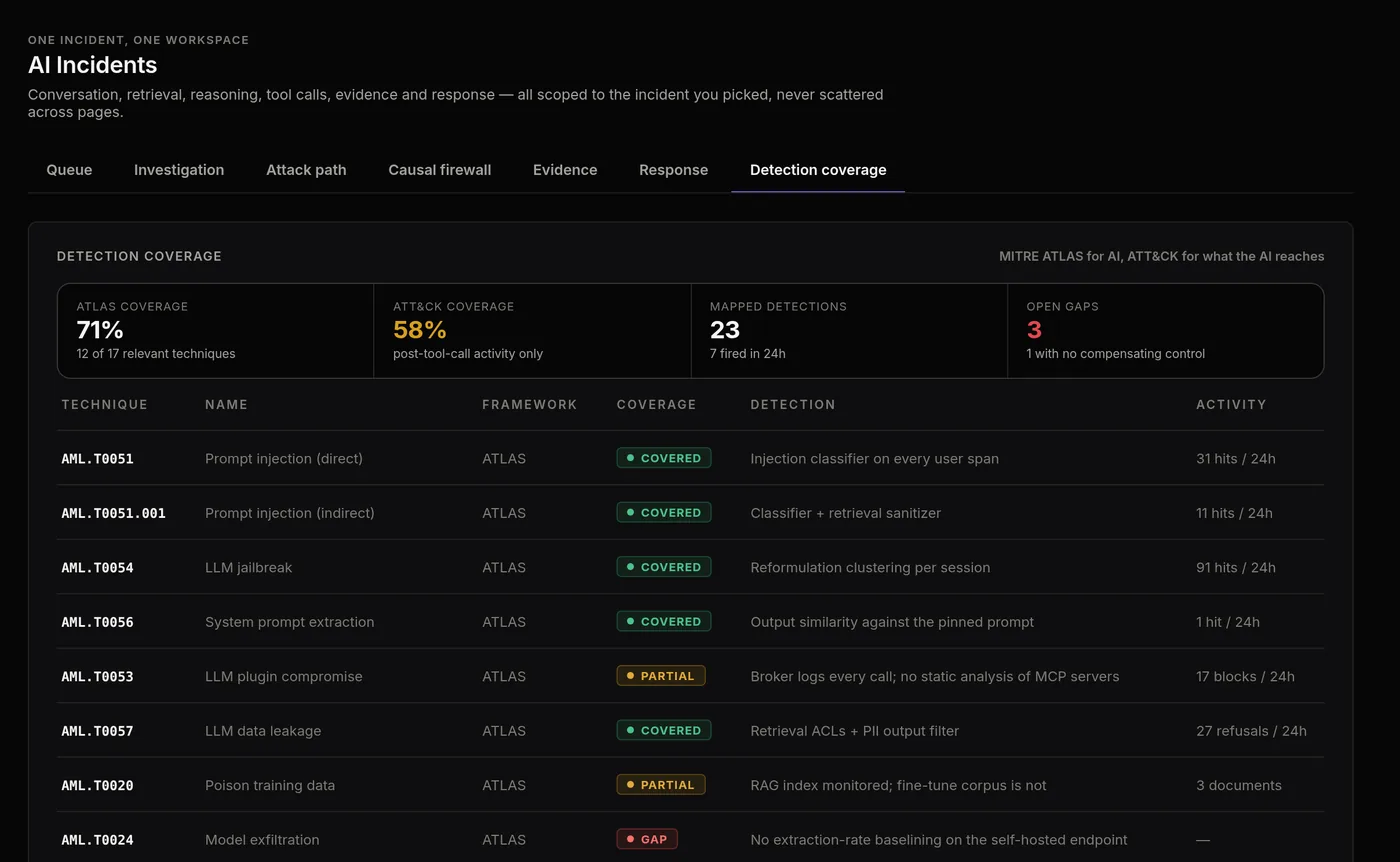
The console's Detection coverage tab lists the MITRE ATLAS and ATT&CK techniques these concepts describe, which built-in rule covers each, and how often it fired in the last day. A gap is shown as a gap, with what would close it.